
 1 hour ago
1
1 hour ago
1
Here's what's going on around the league after the trade deadline

Aug 5, 2026 at 8:46 am ET • 6 min read
The trade deadline has come and gone and dozens of deals were made within the last week. Now that all the midsummer pomp and circumstance (draft, All-Star Game, trade deadline, etc.) is in the rearview mirror, it's time to focus on the actual baseball being played on the field. We're in the dog days of August now. Soon, the postseason and award races will really heat up.
Here now are three things going on around the league to keep an eye on.

Shota Imanaga's high target
Getting rotation help was a must at the trade deadline, and the Cubs did that exactly that with Braxton Garrett, Kevin Gausman, and Clay Holmes. I particularly love Holmes as a fit, given his sinker and Chicago's all-world infield defense. He'll enjoy it there. The new guys will join holdovers Matthew Boyd, Shota Imanaga, and David Peterson in Chicago's new-look rotation.
After a rocky 2025, Imanaga has bounced back nicely in 2026, pitching to a 3.67 ERA in 22 starts and 127 ⅔ innings. He's been especially good lately, allowing two runs or fewer in eight of his last nine starts. You can chalk that up at least somewhat to the hilariously high target Cubs catchers set for Imanaga. Turn on an Imanaga start and this is the norm:
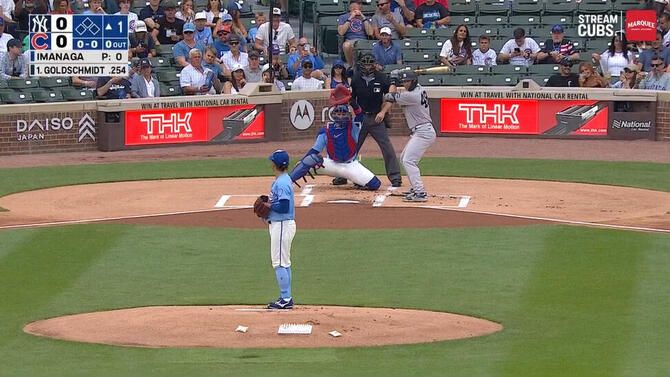
Why do the catchers do this for Imanaga? He pitches up in the zone with his fastball, though it has nothing to do with pitch location. It's to combat pitch tipping. Imanaga had issues tipping his pitches earlier this year, speculated to be due to his glove positioning, and the high target is a visual cue for him to keep it together. It's a real-time reminder not to tip, basically.
The Mets tagged Imanaga for four runs in 5 ⅓ innings on June 24. They had as many swings and misses (three) as homers (also three) against his fastball. The Mets had something on Imanaga's fastball. In his next start, catcher Miguel Amaya set his target way above the zone. That's when this started. The Mets hammered Imanaga and the high target showed up in his next start.
Since that Mets start, Imanaga has allowed seven runs and four homers total in six starts and 35 ⅔ innings. He was giving away something. There was some kind of tell that clued hitters into the incoming pitch. The Cubs and Imanaga caught on and corrected it. Unconventionally, with the high target, but they corrected it. The visual cue has made all the difference.

José Soriano's new batterymates
The Blue Jays toed the line nicely between buying and selling at the deadline. They moved out rentals Kevin Gausman and Daulton Varsho, and also brought in controllable righty José Soriano. Toronto paid a high price in sending top prospect Arjun Nimmala and two others to the Angels, but they got back a good starter who can help them contend in 2027 and 2028.
Soriano came out of the gate like a madman this season, pitching to a 0.24 ERA in his first six starts. One run on a solo homer in 37 ⅔ innings. He's come back to Earth since then: 4.64 ERA in 16 starts and 85 ⅓ innings. No pitcher is actually 0.24 ERA good, so regression was always coming, and it has definitely arrived these last 16 starts. That's baseball.
The Blue Jays are buying Soriano's five-pitch mix, including his quality sinker and great curveball. Hitters miss almost 50% of the time when they swing against his curve. It's a lights-out pitch. The Blue Jays are also buying the idea that their catchers, Alejandro Kirk and Brandon Valenzuela, will get more out of Soriano through their pitch-framing than Angels catchers did.
Here are the numbers going into Tuesday's action:
Blue Jays catchers | +15 (1st in MLB) | 50.1% (1st in MLB) |
Angels catchers | -12 (30th in MLB) | 45.2% (30th) |
MLB average | 47.1% |
Toronto's catchers are five framing runs better than the next best team. Angels catchers are five runs worse than the next-worst team. Soriano is going from one extreme to the next, and yes, framing still matters in the ABS challenge era. You can only challenge so many pitches a game. Catchers still frame plenty of pitches every night.
Furthermore, Soriano lives in the "shadow" of the strike zone, which are those borderline pitches right on the corners and the top and bottom rail. They're 50/50 calls for the home plate umpire, basically. Soriano's thrown 44.4% of his pitches in the shadow zone this year, second most in baseball behind Landen Roupp (45.7%) and well above the 41.5% league average.
The Blue Jays acquired a pitcher who lives on the corners but was stuck with the worst framing catchers in baseball, and will now match him up with baseball's best framing catchers. Kirk and Valenzuela will turn a lot -- A LOT -- of borderline pitches into strikes for Soriano, pitches that were balls in Anaheim. The pitcher/catcher fit could not be much better.

The Rays and Freddy Peralta's changeup
The AL East-leading Rays are, at least on paper, one of the most improved teams in baseball coming out of the trade deadline. They upgraded their catcher situation with Liam Hicks and added the underrated Tyler Wells to the bullpen. Wells strikes me as a candidate to do the reliever-to-starter thing next year. Tampa's done it several times and he has a history as a starter.
The Rays also imported Freddy Peralta to, if nothing else, give them innings over these last two months. More likely, they believe they can get him on track and count on him as one of their postseason starters. Peralta pitched poorly for the Mets (and allowed seven earned runs to the Rockies in 3 ⅔ innings in his Rays debut on Tuesday night), but he was fifth in the NL Cy Young voting a year ago. It's not crazy to think the Rays can get him moving in the right direction.
Chances are that the Rays will have Peralta throw more changeups to righties. Changeups are typically used against batters on the opposite side of the plate. Righties throw them to lefty hitters and vice versa. The Rays, though, have really leaned into same-side changeups the last few seasons. This is counter to the rest of MLB, which has cut back on same-side changeups.
Here are Tampa's same-side changeup rates (right on right and left on left) and the MLB averages, for comparison:
2023 | 13.0% | 21.4% |
2024 | 22.1% | 19.3% |
2025 | 34.9% | 18.9% |
2026 | 27.0% | 16.2% |
Just to be clear, this tells us Rays pitchers have thrown 27.0% of their changeups to same-side hitters this season, not 27.0% of their total pitches. Tampa has actually taken a step back this year, from 34.9% to 27.0%, but they're still well ahead of the rest of the league. The Rays are zigging while everyone else zags. They've embraced same-side changeups while everyone else runs away.
The idea behind same-side changeups is like everything else with pitching: they're designed to disrupt the hitter's timing. If you're a righty, you don't expect to see a changeup from a righty. You're expecting fastballs and breaking balls. This is the way it has been for a very long time. Same-side changeups add a new wrinkle and force the hitter to cover something else. Hitting's hard, man.
Peralta's changeup has been his most used non-fastball over the last two years and, even this year, it's a quality pitch that has generated a 28.1% swing-and-miss rate and an 82.3 mph average exit velocity (MLB averages for changeups: 31.5% and 86.2 mph). Peralta has thrown it 27.3% to righties this year, which is right in line with Tampa's same-side changeup rate.
That same-side changeup rate means Peralta is right up the Rays' alley, and I would expect him to throw even more changeups to righties this year. He's comfortable throwing his changeup to righties and the Rays are fond of same-side changeups, so sure, ramp up the usage and see if that gets Peralta back to being effective, if not excellent. It's at least worth a shot.
.jpg?mbid=social_retweet)

 English (US)