
 2 hours ago
1
2 hours ago
1
“Most people have completely forgotten how chaotic it really was.”

Jeeves lived on a very different web. Credit: Aurich Lawson
Jeeves lived on a very different web. Credit: Aurich Lawson
In the mid-’90s, the web was exploding, but finding anything of actual value on it felt like an elaborate negotiation with whatever proto-search engine happened to be standing closest to the door. Unlike now, when Google is widely seen as both portal and gatekeeper, sites like AltaVista, Lycos, Excite, HotBot, and Ask Jeeves promised to tame the chaos, each with its own suite of quirks, charms, and flaws.
The real story of pre-Google search is not that early engines were inferior. It’s that they reflected a different Internet entirely, one where directories mattered, crawling was still an art, ranking was fragile, and the idea of “search” had not yet hardened into a single dominant interface.
A different kind of web
The first thing to remember about the pre-Google Internet is that there was no built-in assumption that you could search for everything. Many users found pages through Yahoo-style directories, bookmarks, newsgroups, email signatures, and links from site to site because the web was still small enough that human organization could compete with machine indexing. It was an era of Wild West-style discoverability. Search engines existed, but they were only one part of a larger ecosystem that blended curation and accident.
Before those engines became the main public interface to the web, resources like Usenet were showing people how to organize and discover information online. Conceived in 1979, it gave users topic-based newsgroups and a culture of distributed discussion that made online information feel social and communal before the first major web engines arrived. Usenet helped establish the habit of navigating vast, messy digital spaces through categories and communities rather than a single search box.
Nicole M. Radziwill worked as a systems administrator, programmer, and project manager, among other things, in the ‘90s. She remembers Usenet as a portal to unearthing interesting content online. “It was the way to find out about websites that might interest you,” she said. “I got on Usenet in 1990 as a student in Durham, North Carolina… it was delightful, especially the alt.* and misc.* groups. People would put links in at the bottom of their posts, and awareness grew organically. And if you wanted safer or more reliable recommendations, you could limit yourself to moderated groups.”
It was an era when the term “discovery” carried actual weight, when you could authentically be one of the first people viewing a piece of content, regardless of its quality or how long it may have existed—an era of equal parts wonder and frustration.
“Then a couple of years later, webrings popped up,” Radziwill said. “You’d get a block of code and put it on the bottom of your site’s HTML page, and it would embed a link to the next website related to this one. Someone else would manage the list of what could come next, so it was a great way to increase your exposure. The people putting together the lists for the webrings were generally pretty upstanding, so we didn’t even think about sabotage.”
Webrings are another pre-Google artifact that recalls an era when microcommunities sprang up, not unlike those in the BBS era, from groups of people sharing niche interests, sometimes even local to one another in the real world. Before monolithic aggregators like Reddit, webrings were one of a handful of ways to find sites focused on the topics you were interested in.
That mattered because the web had not yet become a pure retrieval machine. It still had a culture of exploration, and many services were designed to help users browse topical categories rather than fire a query into a universal index. In that world, a webring or directory was not a compromise. It was often the main event.
Directories before algorithms
Yahoo is the best-known example of this early logic. It began as a human-edited guide to the web, organized into nested subject categories and maintained by people rather than fully automated ranking systems. For a young web, that approach was surprisingly effective: Human editors could identify quality sites, filter obvious junk, and impose a sense of order on a medium that was still expanding rapidly.
“I was a sysadmin for an ‘ecommerce shop’ in 1995 and 1996,” Radziwill told me, “and when we would turn up websites for new clients, the highlight of our process was submitting the site to Yahoo. Yahoo was like the Yellow Pages, but only for websites. There was a form you would fill out, and you had to justify to the real people at Yahoo that this business you were submitting was legit and important enough to be in Yahoo’s main directory.”
That kind of human curation is almost unimaginable now.
“I remember one time submitting the website for a regional branch of the American Cancer Society and getting rejected because it ‘wasn’t significant enough,’” Radziwill said. “They recommended we contact the main ACS and have them link the site from their page… that they didn’t have yet.”
It was a time when getting accepted into a directory like Yahoo by their human moderators was a massive badge of honor. But the model had obvious limits. Human curation couldn’t scale forever, and it became more expensive and less timely as the web ballooned and content outpaced curation. The moment the number of pages outstripped the number of people who could reasonably classify them, the future belonged to crawlers and ranking systems.
The rise of crawlers
Search engines of the era confronted the scale problem with software. Many of the first big commercial systems, like AltaVista, Lycos, Excite, and HotBot, used crawlers and indexes to automatically map a growing web rather than relying on editors to hand-classify every site. While these engines didn’t all work the same way, they shared a core ambition: to gather up as much of the web as possible and let the algorithm sort through the mess.
It may sound obvious now, but it was a leap at the time. AltaVista in particular represented a major step forward, combining a fast crawler with scalable indexing software, and was already handling millions of HTTP requests per day shortly after launch. It made search feel less like browsing a catalog and more like querying a giant machine.
AltaVista’s moment
AltaVista became one of the defining search engines of the 1990s because it was fast, broad, and unusually capable for the time. Later versions supported natural language-style searches and gave users the sense that the web could finally be approached as an indexable whole, even if the results were still rough around the edges. In a decade when many people were still learning what the web even was and grappling with its vastness, it felt close to miraculous. But it was still a very limited tool compared to the hyper-sophistication of an evolved engine like modern Google.
Mark Friend, director of the IT support firm Classroom365 Limited, worked as a systems operator in the late ‘90s. He remembers that in the pre-Google era, searching the web was both a technical skill and an art form.
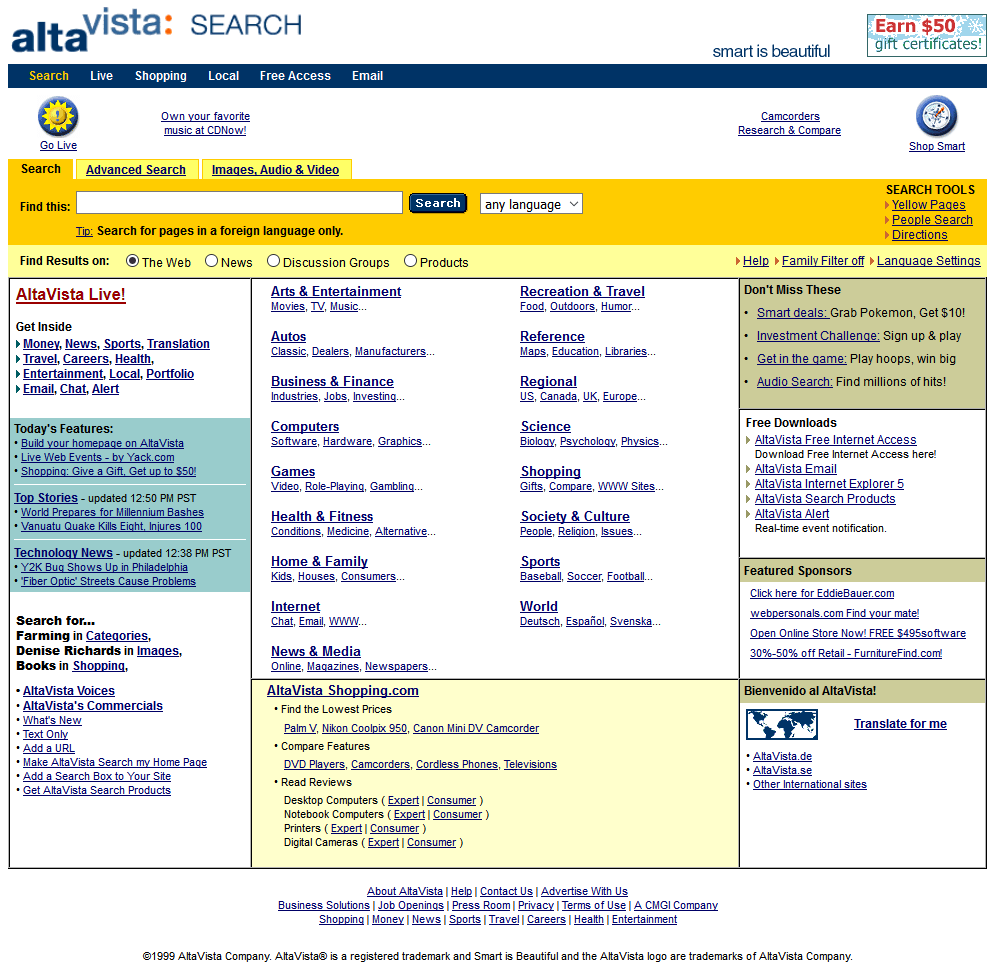
Altavista in 1999.
Altavista in 1999. Credit: Web Design Museum
“Most people have completely forgotten how chaotic it really was,” Friend said. “Back then, if you typed a question into AltaVista, the odds were stacked against you if you were looking for anything specific. You’d receive 40,000 results that would leave you just as confused as shouting into a crowded room.”
Compared with Google’s once-user-friendly UI and more relevant results, combing through an AltaVista results page required patience and genuine skill that was honed over time. But AltaVista did accomplish one important thing: It set the expectation that search should be immediate. That expectation proved decisive. Once users experienced a search engine that could quickly sweep a huge index, they stopped accepting sluggish, partial systems as sufficient. AltaVista didn’t win the search war, but it clarified the rules of engagement.
Lycos, Excite, and the portal era
Lycos and Excite occupied an important middle ground. They were search brands, but they were also portals, meaning they strove to be destinations as much as tools. Search lived alongside breakouts for news, email, sports, weather, finance, and other content, all designed to keep users on the site rather than springing off to results pages.
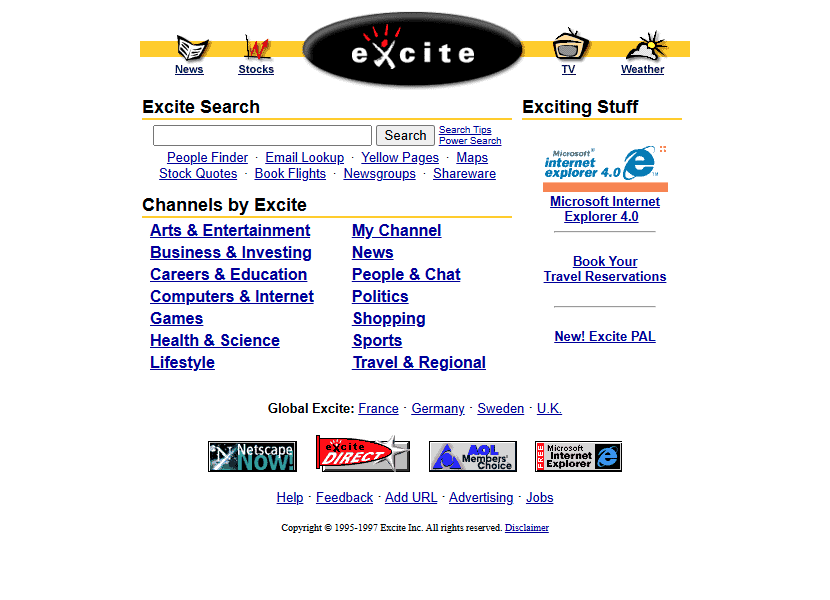
Excite in 1997.
Excite in 1997. Credit: Web Design Museum
These companies demonstrated how unsettled the category was. Some engines emphasized breadth, some emphasized speed, and some blended editorial channels with automated results in ways that feel alien today. The “search engine” label covered a wide range of products, from directory services and crawlers to portals with search bolted on as a tertiary feature.
HotBot, Inktomi, and technical credibility
HotBot earned a reputation as one of the more technically serious search engines of the era. It arrived during a period when users were beginning to notice that search quality depended on both the size of the index and the sophistication of the ranking system behind it—the scalable backend was provided by Inktomi. A fast crawl was not enough; people wanted results that were relevant, current, and not obviously gamed.
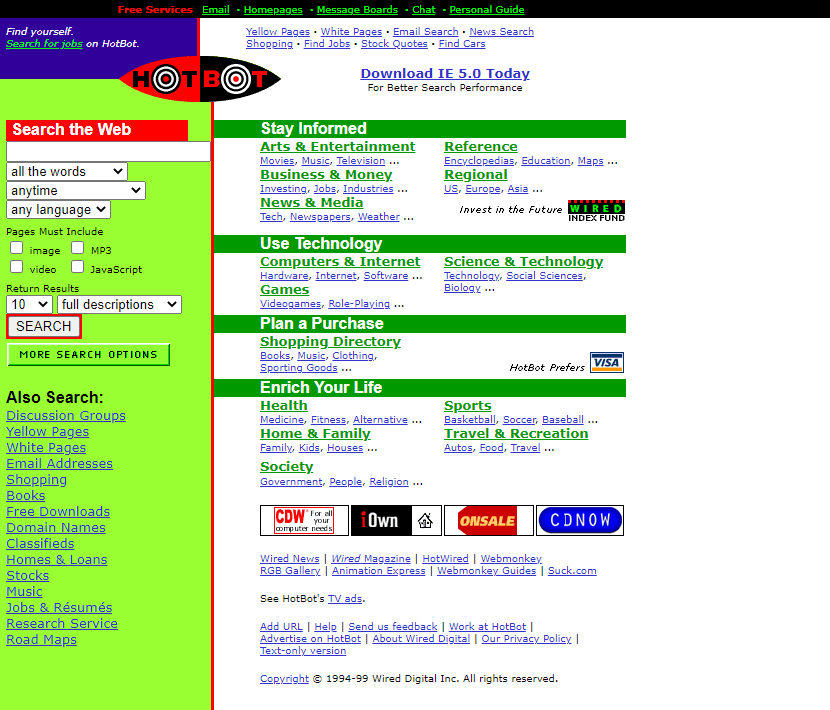
Hotbot in 1999.
Hotbot in 1999. Credit: Web Design Museum
That tension exposed a weakness in the early generations of machine-based search. If a system leaned too heavily on on-page textual signals, people could just overstuff their content with word bloat to artificially boost ranking. If an engine relied mostly on easily manipulated on-page signals, marketing could overpower quality. The early web quickly became a laboratory for manipulation, even before anyone used the term “search engine optimization” (SEO) in the modern sense.
Ask Jeeves and the question interface
Ask Jeeves stood out because it tried to make search feel conversational, an idea that feels especially prescient in the age of the AI chatbot—though Ask Jeeves obviously did not offer anything close to the conversational interface based on today’s large language models. Mark Friend said Ask Jeeves felt genuinely futuristic because instead of asking users to think in keywords, it invited them to query in natural language, giving the impression of a web managed by a knowledgeable assistant.
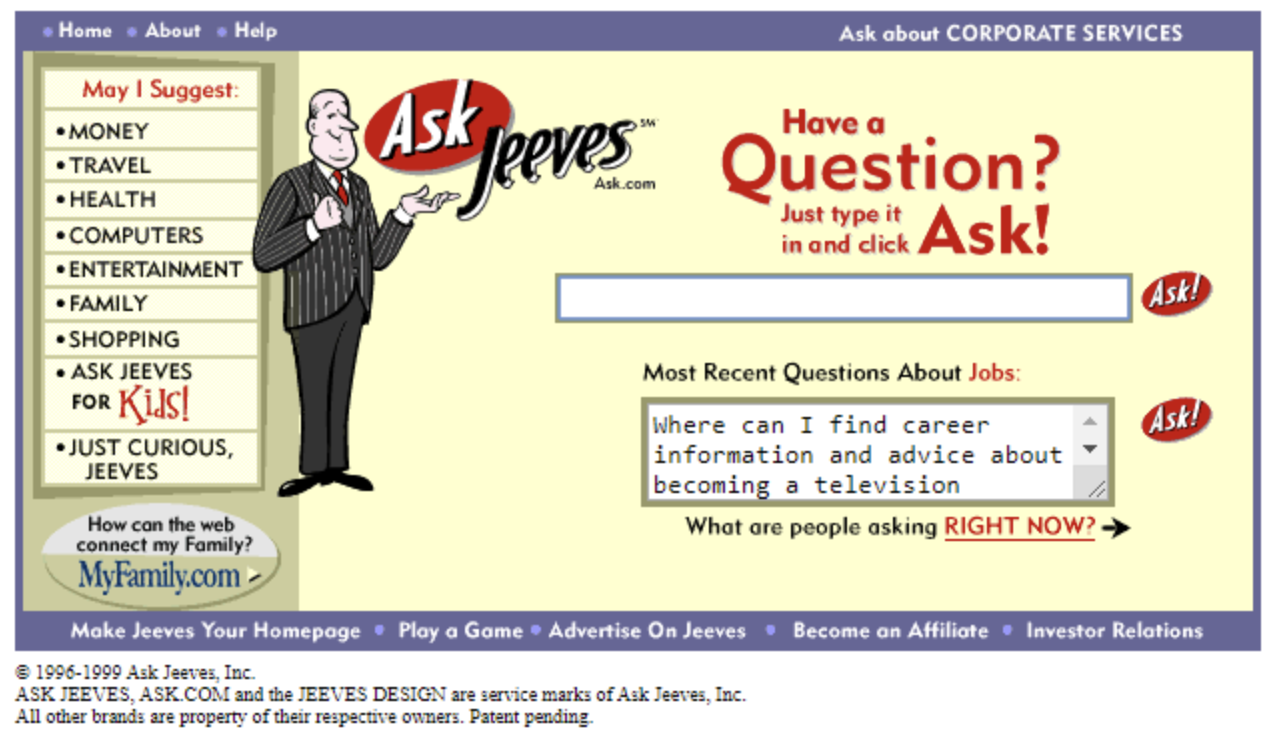
Ask Jeeves in 1999.
Ask Jeeves in 1999. Credit: Web Design Museum
The problem was that natural language is hard. Users didn’t always ask clean questions, and the underlying systems were not yet good enough to infer intent reliably at scale. Ask Jeeves was memorable because, without the underpinning of deep learning and LLMs, it purported to understand the user experience better than the technology of the time could support.
Search before SEO
The pre-Google web was also a pre-industrial SEO environment. Site owners tried to improve visibility, but the modern system of search optimization had not yet become the massive, professionalized discipline it later became, with full departments of “experts” chasing ephemeral signaling from Google and attempting to predict its next mysterious pivot. Early engines were still relatively easy to influence with obvious signals like keyword repetition, metadata, and submission tactics.
“People didn’t talk about ranking back then,” Friend recalled. “They submitted their URL and waited patiently to see if it would show up in a search. Everyone took the Meta keyword tag seriously and the practice of utilizing ‘white text on a white background’ to hide hidden keywords was a legitimate tactic that webmasters would use to include keywords in their website for search engine crawlers. There was no fear of penalties, and you built a website, crossed your fingers, and hoped for the best.”
By the late ’90s, engines were identifying the white-on-white approach as spamdexing and taking action. In any case, that meant ranking was both simpler and more fragile than it is today. The early search web was an experimental stage where the rules had not hardened, and the feedback loop between publishers and engines was still manageable and easier to test and interpret. Once search became the main gateway to the web, that open-ended environment collapsed into a more adversarial one.
“The hard truth that most people do not want to face is that scraping and ranking turned the Internet into a manufacturing facility of content,” Friend said. “Websites went from being written for people to being written primarily for search engine crawlers.”
PageRank changes everything
Google’s crucial contribution was not that it discovered search; it was that it changed the logic of ranking. Among other things, PageRank treated links as signals of authority, which made relevance partly a question of how the web itself pointed to a page. It marked a major shift because it made results seem more trustworthy and made simple manipulation harder, though obviously not impossible.
Just as importantly, Google paired that ranking approach with a stripped-down interface and a results page that got out of the way. The clean design mattered because it reinforced the sense that search should be a utility, not a portal amusement park. In practice, Google made the search box feel like the front door to the whole web, with the same intrinsic, vital importance that a front door serves in a home.
Why the old web mattered
In retrospect, the pre-Google era was slower, messier, and in many ways less efficient. But it also had more competing ideas about how information should be found, categorized, and judged, alongside a lawless atmosphere that suggested unlimited potential. Some systems trusted people. Some trusted crawlers. Some trusted directories, and some trusted questions phrased in plain English.
“The Internet contained an inherent level of clutter and chaos,” Friend remembered. “But at the same time, it was a much more humanized place before. It’s why many of us feel nostalgic for that time. The Internet had an artisanal feel to it. It was made by real people using text editors such as Notepad and Dreamweaver. You might start at one destination and find yourself at a fan site of an obscure band, and then end up at a forum discussing vintage synthesizers, and ultimately end up on a NASA page.”
That diversity is worth remembering because it shows that search was never necessarily destined to look the way it does now. The pre-Google engines weren’t just failed precursors. They were serious attempts to address a problem that the web had made urgent but not yet solvable in one obvious way. Google won by combining technical rank, usability, and scale at exactly the moment the rest of the Internet was ready to abandon the old order.


.jpg?mbid=social_retweet)




 English (US)