
 3 months ago
34
3 months ago
34
“As space becomes increasingly strategic, access is no longer a luxury.”
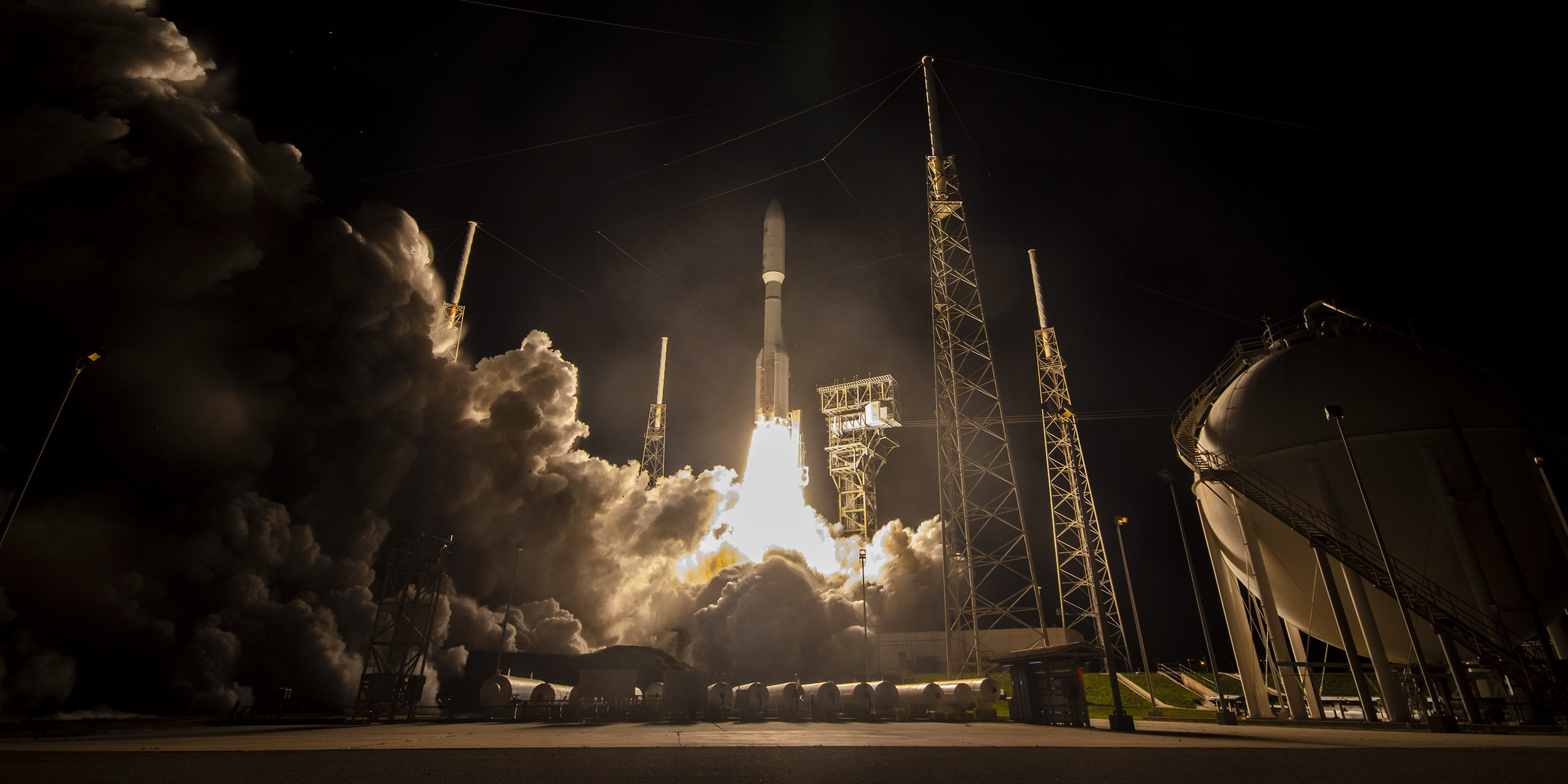
The Atlas V rocket launches its heaviest mission to date on April 4. Credit: United Launch Alliance
The Atlas V rocket launches its heaviest mission to date on April 4. Credit: United Launch Alliance
Welcome to Edition 8.36 of the Rocket Report! Thank you for your indulgence of our missing the report last week, as we focused on the launch and progress of the Artemis II mission. And we are so thrilled it has been going smoothly, with brilliant imagery of the far side of the Moon. Of course, arguably the most difficult part of the flight remains ahead of the crew and Orion spacecraft: atmospheric reentry on Friday evening. We will, of course, have full and continuing coverage for you.
As always, we welcome reader submissions, and if you don’t want to miss an issue, please subscribe using the box below (the form will not appear on AMP-enabled versions of the site). Each report will include information on small-, medium-, and heavy-lift rockets as well as a quick look ahead at the next three launches on the calendar.

Alpha rocket may launch offshore. Seagate Space Corporation announced on Monday a “memorandum of understanding” with Firefly Aerospace to explore the development of an offshore launch platform that enables a sea-based launch capability for the Alpha rocket. Seagate Space said it will work closely with Firefly to mature the design of an integrated offshore launch system capable of supporting Alpha.
A clean break … “Partnering with Firefly to align our Gateway platform with their Alpha vehicle is a major step toward making offshore launch a practical reality for the industry,” said Sean Fortener, president and COO at Seagate Space. The company said its Gateway technology represents a “clean break” from legacy barge conversions and repurposed vessels. The launch platform would open up additional orbits and inclinations for Alpha.
Isar Aerospace stands down from Thursday launch attempt. The Germany-based launch company had said its latest launch window for the second launch of the Spectrum rocket would open at 20:00 UTC on Thursday, April 9. However, about an hour before the opening of the window, the company said it was standing down to “evaluate a suspected leak in a composite overwrapped pressure vessel (COPV). The teams are assessing and will determine next steps.”
Seeking to be the first … The launch attempt from a site in Norway follows the initial flight of the Spectrum rocket about a year ago, during which the rocket cartwheeled upside-down and fell a short distance from its Arctic launch pad. Isar is attempting to become the first European launch startup to reach orbit. The Spectrum rocket is designed to have a lift capacity of up to 1 metric ton to low-Earth orbit.
The easiest way to keep up with Eric Berger’s and Stephen Clark’s reporting on all things space is to sign up for our newsletter. We’ll collect their stories and deliver them straight to your inbox.
PLD Space secures bank loan. Spanish launch services provider PLD Space has secured a 30 million euro ($35,111,839) loan from the European Investment Bank, a month after closing a 180 million euro ($210,671,034) Series C funding round, European Spaceflight reports. PLD Space made the announcement on Tuesday, explaining the loan would fund “the final development stage” of its MIURA 5 rocket. While the company did not disclose detailed terms of the loan, it confirmed that the financing would take the form of venture debt, which is repaid directly over time rather than exchanged for equity.
Access now “essential” … “As space becomes increasingly strategic, access is no longer a luxury. It is essential to our security, our economy, and our future,” said European Union Commissioner for Defense and Space Andrius Kubilius. The Series C funding announced earlier will be focused on what comes next, with the company scaling production and industrial infrastructure as it prepares to transition to commercial operations following what it hopes will be a successful inaugural launch. The two-stage MIURA 5 rocket may make its debut later this year.
Phantom Space acquires thermal components company. Phantom Space said on April 2 it had acquired Thermal Management Technologies, a company that builds advanced satellite thermal components for in-space applications. With the acquisition, the Arizona-based rocket and satellite developer is aiming to spur development of its in-orbit data center constellation—called Phantom Cloud—which is targeting an initial deployment in mid-2027, Payload reports.
Waiting on Daytona … “TMT’s technology is a critical piece of the puzzle for our constellation,” Phantom CEO Jim Cantrell said. “They have deep expertise in satellite thermal components, and we see immense potential in their technology to improve the performance and reliability of our orbital infrastructure.” Phantom is also developing the Daytona launch vehicle, the debut for which has now been pushed back to the “latter half” of 2027. Also, it’s hard to believe, but we recently passed the fifth anniversary of the infamous Phantom rendering. Time flies even if rockets do not.

Tianlong-3 fails on debut launch. The first launch of the Tianlong-3 rocket from Chinese commercial firm Space Pioneer failed Friday after suffering an anomaly in its ascent phase, Space News reports. State media Xinhua confirmed the failure with a short text report a few hours after liftoff. The specific cause is under further analysis and investigation, the report stated. Space Pioneer is one of the more promising Chinese launch startups, raising funds of $350 million to date.
Intended to compete with the Falcon 9 … Tianlong-3 is a 72-meter-long, two-stage launch vehicle using a kerosene-liquid oxygen propellant mix. Designed for partial reusability, it is capable of carrying 17 to 22 metric tons to low Earth orbit. The first stage is powered by nine Tianhuo-12 variable thrust engines. The rocket is among a number of new, potentially recoverable rockets developed by commercial and state entities preparing for debut flights, including the Zhuque-3 and Long March 12A. Both rockets successfully reached orbit but failed with first-stage recovery attempts in December.
Ariane 6 may be comparable in price to Falcon 9 in some cases. The European Space Agency has disclosed that launching the Sentinel-1D Earth observation satellite aboard an Ariane 62 rocket in November 2025 cost 82,070,773 euros ($96,055,192), European Spaceflight reports. ESA’s disclosure marks the first public indication of Ariane 62 launch pricing, enabling a more direct comparison with other launch systems such as Falcon 9.
Different customers, different prices … In December 2022, NASA, in partnership with ESA, announced that it would launch the Sentinel-6B mission aboard a Falcon 9 at a cost of approximately $94 million, around 90 million euros ($105,335,517) at December 2022 exchange rates. On this basis, Ariane 62 appears broadly comparable in price to Falcon 9 for dedicated institutional missions. However, SpaceX clearly has a sliding price scale, and it is believed to have an internal launch cost for its own Starlink missions of approximately $15 million.
Falcon 9 stretches its reuse milestone. SpaceX’s fleet-leading Falcon 9 booster made a record-breaking 34th flight on March 30 with a mission to deploy a batch of 29 satellites for the company’s Internet service, Spaceflight Now reports. SpaceX is currently targeting up to 40 uses per Falcon 9 first stage.
Accumulating a lot of experience … Booster 1076 entered the SpaceX fleet in 2021 and since then has launched missions including CRS-22, Crew-3, Turksat 5B, Crew-4, CRS-25, Eutelsat Hotbird 13G, SES O3B mPOWER-A, PSN Satria, Telkomsat Merah Putih 2, Galileo L13, Koreasat-6A Crew-6, and USSF-124, plus 22 batches of Starlink satellites. (submitted by EllPeaTea)
Atlas V launches heaviest payload. United Launch Alliance launched its latest Atlas 5 rocket, which carried a batch of 29 Amazon Leo satellites to low-Earth orbit early on April 4, Spaceflight Now reports. The mission was the largest and heaviest payload carried to orbit by an Atlas 5 rocket to date, according to ULA.
Upper stage performance is key … The previous four missions for Amazon Leo that launched on Atlas 5 rockets carried 27 satellites each. ULA and Amazon Leo were able to increase the payload stack to 29 as “a result of detailed engineering work between ULA and Amazon,” according to ULA. Amazon pointed to ULA’s use of the RL10C-1-1 engine on the rocket’s upper stage as a key reason why they were able to add two more satellites to the mission.

SLS rocket successfully delivers Artemis II crew to orbit. On April 1, the Space Launch System rocket majestically launched the Orion spacecraft into orbit from Kennedy Space Center in Florida, Ars reports. A few minutes after liftoff, as Artemis II headed east over the Atlantic Ocean, the astronauts got their first glimpse of the full Moon through their forward windows. “We have a beautiful moonrise,” Artemis II Commander Reid Wiseman reported. “We’re heading right at it.”
Two for two … The SLS rocket has now launched two times, both successfully. In the days afterward, NASA engineers said the rocket had inserted Orion into its proper orbit with greater than 99 percent accuracy, better even than the Artemis I mission in late 2022. The Mobile Launch tower was being prepared for movement back into the Vehicle Assembly Building in Florida for minor repairs and to prepare for the stacking of the SLS rocket for the Artemis III mission. The program is preparing to support a launch in 2027.
NASA’s Moon program depends on reusable launch. This is not the kind of talk you would hear from past NASA administrators, but it is entirely true. This week, the US space agency’s chief, Jared Isaacman, said almost off-handedly that the long-term success of the Artemis program depended on SpaceX and Blue Origin succeeding with their reusable launch systems, Starship and New Glenn, Ars reports.
Saying truths out loud … “A big key to our strategy—to not just return to the Moon but to stay and build a base—is the rapid reusability of heavy-lift launch vehicles,” Isaacman said during an Artemis II news conference. “The more they get experience doing that, the more options that are available to us for Artemis III.” One of the most refreshing things about Isaacman’s tenure has been his willingness to say true, but previously taboo things out loud.
Starship launch delayed until May. SpaceX’s next Starship test flight will take place in May and not April as previously scheduled, Reuters reports. SpaceX founder Elon Musk posted on social media platform X that the next flight of Starship’s V3 vehicle was four to six weeks away, or in the first two weeks of May. SpaceX’s debut of the V3 Starship iteration has been delayed for months as the company has packed dozens of upgrades into the vehicle to make it more reliable and suitable for NASA missions, like landing on the moon under the Artemis program.
Half a year since previous launch … SpaceX’s previous Starship test launch, its 11th, occurred in October. The final flight of the V2 version of the rocket, this mission was largely successful. The delay comes as NASA is pushing aggressively to accelerate its Artemis program, which will require either SpaceX’s Starship or Blue Origin’s Blue Moon vehicle to land humans on the Moon. So NASA really needs to see Starship flying frequently.
Next three launches
April 11: Falcon 9 | Starlink 17-21 | Vandenberg Space Force Base, California | 02:39 UTC
April 11: Falcon 9 | CRS NG-24 | Cape Canaveral Space Force Station, Florida | 11:41 UTC
April 14: Kinetica 1 | Unknown Payload | Jiuquan Satellite Launch Center, China | 04:00 UTC


Eric Berger is the senior space editor at Ars Technica, covering everything from astronomy to private space to NASA policy, and author of two books: Liftoff, about the rise of SpaceX; and Reentry, on the development of the Falcon 9 rocket and Dragon. A certified meteorologist, Eric lives in Houston.



.jpg?mbid=social_retweet)




 English (US)